Well, term 4 hasn't finished yet, but I think I and my friends figured out why upperclassmen always complained about fourth term. They weren't clear in their explanations, though. From what they said, we thought we'd have a test or two every single day, and they'd all be so hard our brains would leak out our ears.
But thus far this term has still had fewer tests than last term (the final tally for last term was 30 tests in 38 days of class... as of today we've only had nine tests in fifteen days), and they haven't really seemed any harder than last term. The issue appears to be that this term is just HORRIFICALLY BORING. Maybe it's because we're not doing much with any animals in class. Or maybe this is the hump term of school--our Wednesday of sorts, and we just have to get through it, and we'll be over half-done, and time will speed up again. Who knows. But it's been rough. There have been some good moments, though.
For one thing, during first term I got really close with a group of girls, but we got split up for second and third terms. I was with one of them through those terms, which was awesome, but I very much missed the others. But this term we're all back together again! In the meantime, I got closer with some other excellent ladies. But this term has definitely been filled with good times with all my friends. Multiple times they've proved how awesome they are; making sure I got study packets when I was sick and missed a day, being encouraging and kind in general, and just generally making time at school a really positive experience... even when I'm not feeling great, and even when we're all just trying to survive the next test.
A second thing happened which has helped make my future career goals more clear. Our Animal Tech class this term is Everything Laboratory Animal, basically. So that means really in-depth info about mice, rats, and other common lab animals.
The professor worked at Pitt's research lab for years and loved it. Last week after class one day she told me that I should try to do my externship at Pitt because "[I] have the scientific mind and would really be able to appreciate the research environment." Now, my head immediately swelled several sizes (I'm a sucker for praise from people I have respect-crushes on).
Visions of accolades danced in my head for days.
Now, I was 95% sure I had no interest in pursuing lab work as a career, but I'm always up for learning new things, so to do my externship at Pitt would be almost ideal; I could see what really goes on in a research lab, be involved in actual research, learn a ton, have a great addition for my resume, but then after the two month externship, move on to vet tech work I'm more interested in.
But the more I thought about lab work, the more I realized I didn't want to do it--at all. It's all well and good to say that laboratory research is going to help other animals and people (which it definitely is), and that there are lots of regulations that mean animals get analgesics and such if they need them. But the fact of the matter is, those animals are still almost all going to be euthanized when research is over (sometimes before, since the researchers need to run tests on body systems or need amounts of blood that a single, live, tiny mouse can't provide and still live to tell about it), and a lot of the research involves giving them terminal diseases... on purpose. I can deal with the animals at school getting poked and prodded because after six month's time they get adopted and [mostly] get really good homes. But lab animals usually don't. I dislike doing uncomfortable procedures on animals at any time, but knowing that it's not even to make them better or healthier, but rather harm them (even for the "greater good") makes me queasy.
Despite all this I was still talking myself into pursuing it. Why? Because I have always hung out with brilliant people. Not just smart people, but brilliant people. I got born into a family of them, some of my siblings are them, a lot of family friends are them... I grew up surrounded by brilliant people. Because of that I've had a pretty great education. But I'm not brilliant myself--I don't have the talent or the drive.
In college, I chose "enough sleep" 9 times out of 10, and tried to split the rest of my time equally between achieving the other two goals, and didn't really care if neither were achieved.
But here's the issue; for the entirety of my life, brilliant has been the norm. Brilliant is expected. It's just sort of assumed. Don't get me wrong, brilliant is pretty cool--I've learned all kinds of really fascinating things, and know people from all sorts of scientific, artistic, and philosophical backgrounds. If I have a question about something, chances are good I know, or have some connection to somebody actively working at a doctoral level in that particular field. I love that. I love learning. I love knowledge. But I have no desire (currently) to pursue further academic degrees.
I don't want to be a vet; I want to be a vet tech.
But I do want all those brilliant people I know and respect to respect me and ascribe to me the same brilliance they have. I like being thought of as "smart." And I am. But I come from a place where the average intelligence is master's level at the least. That's unusual, so I know my perspective is skewed. But being able to say that I have a "background in research" basically assures me a seat amongst the academics.
Luckily the majority of the brilliant people I know respect tradespeople. I know they don't think I'm dumb because I want to be a vet tech. But I think some of them sort of assume it's only a step along the path to being a full-fledged DVM or veterinary medical researcher.
Maybe I could do it. Maybe I could go to vet school and do great. But I don't want to. I don't want to go to school for years or spend months writing research grant proposals. It would drive me crazy. I love working with my hands, and I love animals. I love working with my brain, as well--but more as a sort of hobby.
Being a Vet Tech involves a lot of abstract brain work, don't get me wrong--but it's all directly tied to the practical. I need to know all the intricacies of how and why a dog might get infected with Dipylidium caninum, and what to do about it, but I've still got an actual animal standing in front of me. Showing clinical signs. Actual tests I can physically run. Things I can see, things I can do. The abstract knowledge is tied directly to the physical reality, and that's the way I like it; that's the way that makes sense to me.
I know this about myself, and I love this about myself. But I also want to be brilliant.
"But you'd hate it," Garrett said. "You'd hate working in a research lab."
"I knowww," I whined. "But I'd learn so much! People would think I'm a smartie!"
"They already do," he said. "You don't need to be doing something you'd hate to try to prove something people already know."
"But if I did research it'd be OFFICIAL that I'm smart."
Then, of course, I accepted what I'd already known--I didn't want to do it for the love of the thing. Yes, I would appreciate having a more intimate knowledge of how research is conducted. But I can always ask all the people I know who already work in research. I didn't care that I might indirectly be saving thousands of human and animal lives in the future by giving mice cancer now; I would have to steel myself every day and hate myself a little bit more every time I injected another one.
It's not like I'm not going to egg researchers' homes or anything--it is indisputable that they have saved countless lives--but I don't want to personally be involved in it if it involves harming many other little creatures.
What it comes down to is that I just want to convince myself that I'm brilliant, and have other people recognize it.
This is, needless to say, fruitless and vain.
So I'm going to concentrate on regular clinic work, but seize any opportunities I can to also work with exotics and large animals. There: immediate relief.
Or why not both exotic AND large?
But parrots are pretty great...
And I definitely need horses in my life at all times...
Basically, there are a ton of other things I could be doing as a Vet Tech that I would absolutely love.
My mom once introduced me to someone as "our closet academic." I like that. I'll take it.
I love what I am learning at school, and what I'll be doing in practice, and I have found my niche; I am content.
So now that all that rambling is over and done with and given to the wind I'll leave you with this moment from last week...
Clinical Lab this term is all about cytology--tumor biopsies are obvious topics, but also we've covered fertility-related cytology (most common with breeding animals).
Female cytology lecture and lab wasn't too bad. But male cytology... well. Our professor started out the lecture with this comment:
"I'm going to talk about the procedure first, and then we'll go to the powerpoint. The pictures are a bit distracting."
You will understand why if you choose to watch the following video of Garrett reading aloud my notes from that class. I give it a strong Awkward/PG-13 rating. Proceed at your own risk.
And yes, I checked with him to be sure he was okay with me posting it.
"Yeah," he said. "I'm narcissistic enough I don't mind."
I have had Sir Percy since I was 9 years old, and he was <1.
He is now 16. That is a lot of years we've been together.
When I was young and foolish, my siblings and I used to play "birdie ball" where we would sort of chuck him across the living room to make him fly back and forth between us. He still lets me hold him now, so hopefully he's mostly forgiven me. I'm sorry, Pretty Bird.
"It's okay."
Once, Sir Percy was walking along the floor and Dad rolled over his little foot with a computer chair. He's been missing that one back claw for years now since it happened. But he still climbs up and down his cage with ease. The top is his favourite place to take a little snooze.
Zzz.
Until some jerk comes along and wakes him up with a camera.
My parents originally promised me I could have a bird to prove I was responsible enough to have a dog. But, as it turned out, my great Aunt Carolyn and Uncle Mike found our perfect dog for us a few months before I'd even gotten Sir Percy. We all trekked out to their gorgeous farm on the Tennessee river and what they'd tried to convince my Dad of over the phone was made abundantly clear in person--yes, a German Shepherd could be the perfect family dog for four young children.
Playing during a rare snow in TN.
Exploring the new PA neighbourhood with Ben.
She even attended a creeking at GCC during my college years.
Cani and Annabelle.
She remained the best dog until she died in 2011 at age 13, and now there is a dog-shaped hole in my heart, waiting for the time and space to to fill it again.
But anyhow, after getting Cani-dog all those years ago, my parents decided they'd still get me a bird, so I received Sir Percy for my 9th birthday a few months later. He was hand-raised by a breeder in Jackson, TN, and Dad went and watched that batch of babies for an afternoon one day before picking out Sir Percy to be my companion.
He was a pretty great pet. I mean, other kids didn't have little parrots, and I did. It was awesome.
Sir Percy has witnessed a lot in his time with me, and quite a few pets have come and gone since he's been here. We've had a random variety of snakes, a few turtles (including a little snapper!), a couple goldfish, and some wildlife.
He ignored Weepers, a sparrow I raised.
"Why is that thing here?" he said. "Who even keeps birds as pets? Ugh."
I don't recall him having any animosity towards my squirrel, though.
Me and T.J., both of us still young.
Sir Percy lived through encounters with a number of cats.
Figwit, who liked jumping on the side of his cage and trying to pull it down.
"Just one little taste? Pleaassee?"
Betsy's little kitty, Gillie of Ockham
Guen
Tiny Kitty
Sir Percy has also had to accustom himself to me acquiring a husband, and said new husband's pet, Rad Cherenkov, the beta fish.
So Sir Percy moved to the city with me.
He was fine with the husband.
New perches are always welcome.
He met Rad, decided he wasn't worth bothering about, and never mentioned him again.
Rad is basically a flower that swims around.
Rad, for your information, is almost 4 years old. He is a very hardy beta fish.
Well, I've been trying to read more about cockatiel care on my own, but going to Vet Tech school has opened my eyes to a lot more information that you can't get just by googling "cockatiel care." I decided Sir Percy should probably go to the vet. One of my favourite professors works with exotics and large animals, and when I approached her about it, she recommended a couple clinics nearby. I picked one, made an appointment, and today Garrett and I took Sir Percy to the vet for the first time in 16 years.
I learned a lot.
Firstly, while it's good to fast dogs and cats before vet visits in case they need bloodwork, it is not good to fast cockatiels because they'll tend to hypoglycemia.
Secondly, I learned how a healthy cockatiel's body should feel, and where natural little divets are, and how to tell if the cockatiel has fatty liver disease (a common complaint). Sir Percy has a perfect little body, with no signs of fatty liver disease.
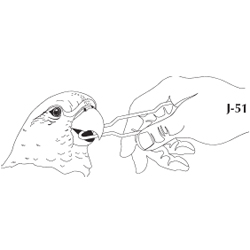
Thirdly, I learned there is this thing called the "choana." It's sort of the nasophanyngeal opening, but it also consists of lymphatic tissues dangling from the top. Basically, it's cockatiel tonsils. In birdies, you want it to be spiky-looking. If they're blunt and dull, it would indicate bad diet and immune issues.
See the little tooth-like things? That's what I'm talking about, and they should look like that.
The vet showed me Sir Percy's choana, and, much to my disbelief, his are super sharp and pointy and not dull at all. So now all I can think about is---did dinosaurs have choana? Like, it wasn't enough they had dinosaur teeth... even their little throat lymph tissue needed to look like teeth?
I think we're going to need a bigger speculum.
See figure J-51.
The vet also commented how nice Sir Percy's crest looks. Usually they're kind of sparse and short by his age. This surprised me, since I'd thought Sir Percy's crest looked a bit ratty. But no, the vet thought it was super fine, even though it bends off to the left a bit.
Super fine neck feathers.
I decided to get him tested for psittacosis (a fairly expensive test, but the disease is zoonotic). I mean, it's been 16 years, but I figured we might as well do it right. We'll get the results from that in a week and a half.
Fourth thing I learned: the vet said that because Sir Percy is so old, he's probably set in his ways, and he wouldn't recommend getting him a birdy buddy, because he probably thinks he's part of our flock and doesn't recognize that he's a bird (which explains why he didn't know what to do with Wheepers). So I guess we're off the hook for that. I do think I want to invest in a new cage for him, though. This one is as old as he is, and actually looks its age, unlike Sir Percy, apparently.
Fifth thing I learned: I love exotics medicine and I definitely want to try to pursue that in addition to large and companion animal medicine.
Sixth thing I learned: Sir Percy weighs 77grams, a nice midway between the 70-85g the vet usually sees in cockatiels. When the vet first saw Sir Percy he thought he was going to be overweight, because he's fluffy-looking, but nope! Healthy birdy weight.
In the end, the vet was awesome, and gave us almost a 50% discount because I'm a Vet Tech student. Yay! Basically, he just charged us for the psittacosis test they have to send out. Sir Percy will be getting yearly check-ups there from here on out, and I'm thinking perhaps I could see about developing a relationship with this practice and either working there, or making other exotics connections through them.
And once I know Sir Percy is cleared of possibly having psittacosis, he can go back to his favourite past-time--cleaning people's teeth.
"Yum. Let's see what we've got back here..."
Special thanks to Garrett, for being my chauffeur and errand-buddy, and Dr. Glenn Marsch, for taking a lot of these photos, and siring me. Here's his flickr account.
We've been covering the reproductive system in A&P, so, naturally, there have been a lot of good quotes.
During these discussions, I've had one burning question building up inside of me. We were discussing the male parasympathetic reflex caused by olfactory cues and behavioural changes in the female, and my time had come. I raised my hand.
"Yep?" said our prof.
"I have a weird question," I said.
"Okay," she said.
"So I used to work with these stud horses... and I swear that whenever I was ovulating, they'd get pushy with me and I had to be a lot firmer with them and, and..."
By this time the whole class was laughing, including the teacher.
"Am I crazy?" I asked.
"No!" said my prof.
"Thank goodness!" I said. "Because it was getting pretty weird when I'd have to come home and tell my husband that the horses all got boners when I walked into their stalls."
"I'm guessing," said my professor, still laughing, "they weren't picking up any behavioural cues from you, right?... but they could definitely pick up hormonal cues. Actually, that reminds me of this gelding I used to have. Zippy. And Zippy shouldn't have been behaving like this, being a gelding. But Zippy would get an erection whenever the farrier pulled up in his truck. It was so awkward."
Hey, hey, hey!
~*~
"Dogs don't have bulbourethral glands. Bulbourethral glands are also called Cowper's gland, after the guy who discovered them, I guess." She paused. "I don't think I'd want an accessory sex gland named after me."
~*~
Discussing mammary glands and that females will continue lactating as long as they are regularly being suckled.
"That's how you end up with people still nursing their toddlers and stuff. Eesh. If you're old enough to go get your own drink, it might be time to move on."
Good grief, look at that kid; he's ready to join the local flag football team.
I guess it's a great diet plan for mom, anyways.
~*~
Fun facts:
Armadillos always give birth to identical quads.
Really interesting and only kind of horrific facts:
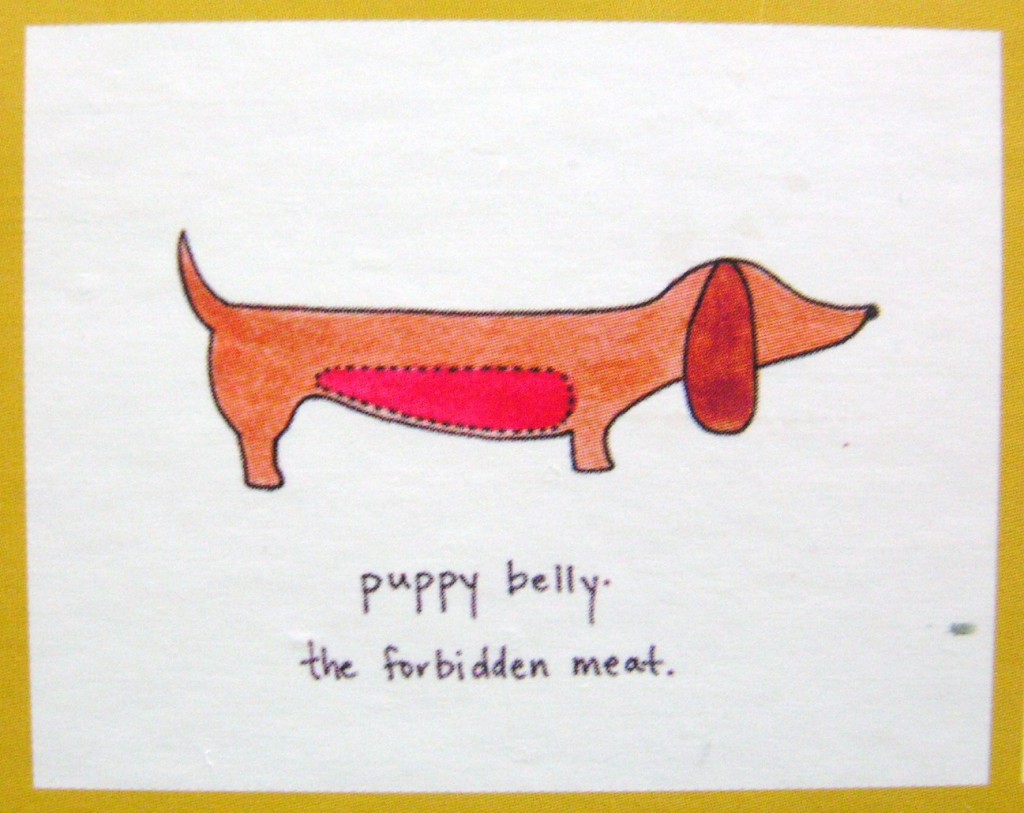
1. Those cute little pot bellies that puppies and kitten have are actually caused by Toxocara spp (roundworm). Puppies are born with it because it goes transplacentally as well as transmammary, and kittens get it immediately after birth because it goes transmammary for them. Also, virtually every single adult dog/cat has encysted roundworm. You can deworm them, but it won't kill the encysted ones, which will just wake up and become adult worms whenever they want to later (which is part of the reason why you have to deworm regularly).
Irresistible!
2. Toxoplasma gondii is the protozoal parasite pregnant women are told to watch out for and why they are warned not to change cat litter for fear of catching this. In reality, you are much more likely to get it from unwashed fruit or improperly cooked meat, but anyways... normally people just fight it off and it's not a big deal, so if a pregnant woman was exposed to it prior to pregnancy, and then exposed again, it wouldn't be an issue because she'd have antibodies to fight it off. But if her first exposure was while pregnant it can cause miscarriage if contracted in early pregnancy, and severe developmental issues in the baby if contracted in later pregnancy.
But besides that, here's the really fascinating thing; it also might be giving normal, everyday people the crazies.
Read this article about it!
Just plain horrific facts:
If you want to know what the parasite Echinococcus granulosus does when it gets into a human (which is not its definitive host, and we'd be better off if we were), you can watch this video. It merits a solid 12 out of 10 on the ick scale.
I've been having issues staying awake in classes this term because of it still being dark when I get up in the morning. I've never drawn so much on my notes before, just trying to look busy.
Please note the obvious lack of actual notes on this particular slide.
"We do not recommend supplements to our veterinary clients," says our Clinical Medicine, and Anatomy & Physiology professor (the same fabulous math prof from first term) during our Clin Med class.
Not okay
"There are some that can be useful in human medicine, but they're not regulated the way actual medications are, and most of the ones you get over the counter aren't even in the correct form for your body to process them. It doesn't really matter how much vitamin D you're adding to your diet--if you're not eating enough fat, your body can't process the vitamin and it's basically worthless. And some supplements would be downright harmful--calcium supplements to large-breed puppies, for example. But some people, I tell you what--they buy their pets supplements and won't listen to a word you say. There was this lady... well, she had issues going way beyond this. This was also the lady who accused us of stealing her puppies. I told you that story, right?"
No, we said. You didn't.
"Well," said Clin Med, "I should tell you that story later, since we're discussing nutrients now."
She stopped and looked at her powerpoint, contemplating. "Actually," she said. "Can I just tell you this story real quick? It's so special."
Definitely, we said.
"Okay, so this lady bought her animals supplements all the time--from human stores--but that's not the fun part. So she had this golden retriever that needed a c-section. She's one of those awful backyard breeders. So she brings her dog in and we do an x-ray, and I tell her, you know, okay, I think I saw maybe 4 or 5 puppies in there, we'll do the surgery, and I'll call you as soon as we're done to let you know how it went, okay? So she leaves, and we do the surgery. There were only three puppies, actually, which is a common mistake to make reading the radiograph because we can keep the momma dog still, but we can't keep the puppies from moving around inside, so a lot of time one puppy will superimpose on itself and look like, you know, three puppies or something.
Pin the spine to the puppy
So I call this crazy lady and tell her the surgery went well, and guess what, your dog is doing so well you can come pick her up tonight. There are three puppies. So she says okay, she'll come get them, and she's bringing the police. And I'm like what? okay? and just hang up, because this lady is crazy, right? So she shows up without the police and is all mad at me and wants to know where the other puppies are. And I'm like there were only three puppies. I miss-read the radiograph, and I explain that whole thing to her.
No, crazy lady says. There should be eight puppies.
Eight? I say. I only told you four or five, originally.
No, she says. I talked to my son, who is a very respected human physician, and he told me there should be eight puppies, and you stole the other five, and I'm going to sue you.
I kind of look at her, thinking, you know, I don't want her inbred golden retriever puppies, and finally I'm like, okay, crazy lady, why do you think there should be eight puppies?
And she says (get this, you guys)... because she has eight nipples!
And I don't even know what to say to that. I just look at her and say that's... not really how that works.
Yes, it is! she says. My son is a very respected physician, and he agreed with me!
I'm like soooo you have a son, right? Like, one son?
And she's all YEAH, what's your point?
And I'm like, nothing. Nevermind. And somehow we convinced her not to sue us. The end."
This person was obviously made to nurse five puppies.
The whole class agreed that was a great story. "Do you have any more?" we asked.
"Oh, my goodness, yes. All from this lady, too. She also sprayed her birds with cologne. Which is very bad for them. We were working on one of them one day and I thought the bird smelled pretty fruity. But you know how animals sometimes kind of smell like the homes they're from? But I sniffed this bird a little harder and it was way too strong. So we finish up the check up or whatever we were doing, and I take the bird back out and I say by the way, you don't happen to, you know, spray cologne on your birds or something, right? And she just gives me this look and says, of course I do--they LIKE it."
They do often enjoy baths.
Clin Med looks out over the class and sizes us up. "We can always discuss this whole nutrition thing later. Want to hear about the time she told us aliens abducted her cat?"
We asseverated there was nothing else in the world we would rather hear about; certainly not the relative dissolve-ability of fat-soluble vitamins.
"Great, because I'm kind of dying to tell this story, now. So she brings her cat in, and she's all shaky--you know? And tells us her cat had been hiding under her bed and wouldn't come out, so she tried to go down and pull him out, and he started talking to her. In English. He told her that aliens had abducted him and probed him and put an alien microchip in his brain and they were keeping tabs on her with it, and she demanded that we remove the microchip immediately. So Dr. L and I are trying really hard not to look at each other, because we'll lose it.
Incidentally, MIB is one of my favourite movies of all time
Okay, says Dr. L, we'll do an x-ray to see if we can find a microchip. So we take the cat back and do an x-ray. You guys. You know the normal microchips? For pets? Well, it's well-known that they can travel around. They're in the subcutaneous space and they can sort of migrate--but they migrate down--to the caudal end, maybe down the legs a little bit. It is extremely rare for them to go anywhere else. Well, you guys--this cat's Avid microchip had somehow migrated out of his scruff, up his neck, and into the SubQ layer on the back of his head. He had a microchip in his head.
So obviously Dr. L and I have a powwow.
What do we do? I ask.
Dr. Lee kind of grimaces. Maybe I should show her an x-ray of a different cat, he says.
You aren't going to do that! I said.
No, I guess not, he says.
So we take the x-ray out and explain that it's her cat's own microchip in the back of his head, and it's not in his brain. But she doesn't care, she demands we remove it. So we do. We make a little incision and squeeze it out and sew him back up. I hand that poor cat back over to her, and he sort of stiffened and just looked at me, begging me, I could see it in his eyes, not to make him go home with her again. But we had to, of course. And what do you know--she calls us later that night and said the procedure worked--her cat wasn't speaking English to her anymore."
~*~
"You guys, if something is oozing pus, the correct term is 'purulent'. Please do not write 'pussy fluid' on your medical forms. They are considered legal documents, and everyone will laugh at you."
--Every single professor
Today I went on a walk in the park with my cousin and her daughter and two dogs. I call her my cousin, because that is the closest approximation of the familial relationship we have. It's complicated.
Our family is much less sterile, and even more fun than this.
Anyroad, we went to hang out, and complain about life, and enjoy the sunshine and each other. All these things were accomplished. As we strolled along, chatting, we came across a group of older walkers, standing in a cluster blocking half the pathway, with their four--unleashed--dogs milling around blocking the rest of the pathway. Now, all dogs are supposed to be leashed in this area, but there's no point making enemies if you don't have to, so we let the dogs all meet (not that we had a choice), keeping an eye on one of my cousin's dogs, who gets nervous and nippy around bigger dogs.
"He's got a bit of a Napoleon complex," my cousin said, later.
Nervous Dog did great, which my cousin commented on, and we continued on our way, exchanging knowing looks about dumb dog owners, only to realize Unleashed Dog #3 was tailing us. The owner came huffing up, eventually, calling the dog, which paid absolutely no attention to her. I was peeved at this point and stood in-between the dogs, trying to block hers from Nervous Dog.
"You don't need to do that!" she said. "[Unleashed Dog #3] won't hurt him!"
"Ma'am, you're supposed to have your dogs on a leash," I said.
"[My Unleashed Dogs] are friendly!!" she said, angrily, as if that made everything okay.
"Well, this dog gets nervous around bigger dogs," I said, pointing to Nervous Dog. "And they're still supposed to be on leashes."
"SHE said he was fine!" Angry Lady said wrathfully, the "she" referring to my cousin and her previous, surprised comment about Nervous Dog's lack of nervousness.
Then we exchanged a few heated comments, hers mostly about us, to her dog she was attempting to leash. She then tried to continue down the path, loudly saying to Now-Leashed Dog #3 "no, I'm sorry, they don't WANT to be friends!"and other such passive-aggressive comments, while interjecting her commentary on us with trying to call Unleashed Dog #4 to follow her. Unleashed Dog #4 did not think she was very important, and continued circling and bothering our dogs.
"You obviously do not have control of your dogs!" I called after her, while we stood still, confident, waiting; interested to see how long it would take before she had to sheepishly come back and physically leash Unleashed Dog #4. It took a lot longer than it should have, then she faded off into the distance again with her animals, complaining about people who won't let their dogs have friends.
Then we passed a pile of steaming doggy poo.
"I bet that's theirs, too," said my cousin.
~*~
After this charming interaction, we went to the off-leash, fenced-in area to let our dogs have some fun. Several dogs and their owners came and went. Then I saw her. A large, fluffy, magnificent German Shepherd.
Such dignity.
"Shepherd!" I said. She turned away from the other dogs she was playing with and looked at me, and made a bee-line for me. I crouched down and she leaned up against me, panting, and let me pet her all over. I found her itchy spot, which she liked, and then after talking to her for a few moments, I figured I should acknowledge her owner.
"What's her name?" I asked him.
"Petra," he said.
Petra, deciding that I was now more interested in her human, and our interview was up, stood up, strode over to her owner, sat down squarely in front of him, and looked up expectantly. He gave her a treat, and made shame-faced eye contact with me.
"She's a therapy dog," he explained, sheepishly. "She marked you as her patient, and gave you therapy, and now she gets her treat."
I laughed. "Well, she was right," I said.
I went home and told the story to Garrett. "The thing is," he said. "She probably did know. I bet she might even have been able to smell and recognize your meds."